Respiratory Therapy · Tools · References · Practice
Clinical judgment, sharpened through respiratory practice.
Calculators with every formula shown, cited guides and references, and board-style practice — built for RT students, new graduates, and working respiratory therapists.
Featured Tools
The calculators and practice RTs reach for most.
ABG Interpreter
Stepwise arterial blood gas interpretation — primary disorder, compensation with Winter's formula and expected-compensation math shown, plus an oxygenation check.
P/F Ratio Calculator
PaO₂ ÷ FiO₂ with Berlin-definition severity bands — mild, moderate, and severe ARDS ranges with the formula shown.
IBW / Predicted Body Weight
Predicted body weight by the Devine/ARDSnet formulas with the full 4–8 mL/kg lung-protective tidal volume table.
RSBI Calculator
Rapid Shallow Breathing Index (f/VT) with the Yang-Tobin 105 threshold — weaning-readiness interpretation with the evidence cited.
ABG Interpretation Quiz
Drill arterial blood gas pattern recognition — read a fresh pH/PaCO₂/HCO₃ panel each round and name the primary acid-base disorder, with an instant rationale and scored ten-question rounds.
Browse by Specialty
Sixteen focused hubs, each pulling its guides, references, charts, and tools into one learning path.
Fundamentals
Anatomy and physiology, gas exchange, V/Q matching, control of breathing, and bedside assessment — the foundation of respiratory care.
Open hub →ABG & Acid-Base
Systematic interpretation, compensation rules, and disorder charts — plus the ABG Interpreter.
Open hub →Mechanical Ventilation
Modes, settings, NIV, weaning, and alarms — backed by calculators and a 30-question quiz.
Open hub →Airway Management
Intubation, RSI, the difficult airway, suctioning, and extubation — with capnography and adjunct references.
Open hub →Oxygen Therapy
Delivery devices, FiO₂ ranges, titration, and the oxygenation indices that drive escalation.
Open hub →Pulmonary Diseases
COPD, asthma, and ARDS management with the comparison charts that separate the lookalikes.
Open hub →Critical Care
Shock, sepsis, hemodynamics, vasopressors, ICU sedation, and prone positioning for ARDS.
Open hub →Aerosol Therapy & Pharmacology
Aerosol delivery and devices, bronchodilators, inhaled corticosteroids, mucoactive agents, and specialty inhaled agents.
Open hub →Neonatal & Pediatric
Newborn resuscitation, RDS, pediatric assessment and vital signs, bronchiolitis, croup, and airway equipment sizing.
Open hub →Emergency Respiratory Care
Acute respiratory failure, the adult code, CO poisoning, tension pneumothorax, and anaphylaxis — recognized fast and managed right.
Open hub →Pulmonary Function Testing
Spirometry, obstructive vs restrictive interpretation, flow-volume loops, DLCO, and bronchodilator reversibility — with a reversibility calculator.
Open hub →Sleep Medicine
Obstructive and central sleep apnea, the polysomnogram and AHI severity, obesity hypoventilation, and CPAP/BiPAP titration.
Open hub →Transport Respiratory Care
Moving the critically ill by ground and air — oxygen logistics, transport ventilators, airway security, altitude physiology, and neonatal transport.
Open hub →Clinical Skills
Hands-on bedside competencies — ABG sampling, pulse oximetry, airway clearance, lung expansion, tracheostomy care, and infection prevention.
Open hub →RT Career & Professional Practice
Credentialing and licensure, scope of practice, work settings, ethics, evidence-based practice, and documentation for respiratory therapists.
Open hub →Labs & Diagnostics
The complete blood count, electrolytes and the anion gap, lactate, cultures, chest imaging, and co-oximetry — reading the labs behind respiratory care, with an anion gap calculator.
Open hub →Featured Guides
Start here — the high-yield teaching pages.
ABG Interpretation Basics
A systematic five-step method for arterial blood gas interpretation — pH, PaCO₂, HCO₃⁻, compensation, and oxygenation — with worked examples and the patterns RTs see at the bedside.
Ventilator Modes Explained
How the main ventilator modes work — AC/VC, AC/PC, SIMV, PSV, PRVC, APRV, and CPAP — built on the trigger, limit, and cycle framework, with watch-outs.
Oxygen Delivery Devices
Low-flow, high-flow, and reservoir oxygen devices compared — nasal cannula, simple and Venturi masks, partial and non-rebreathers, and HFNC — with flow rates, approximate FiO₂, and the bedside rules RTs use to pick the right one.
COPD Exacerbation Management
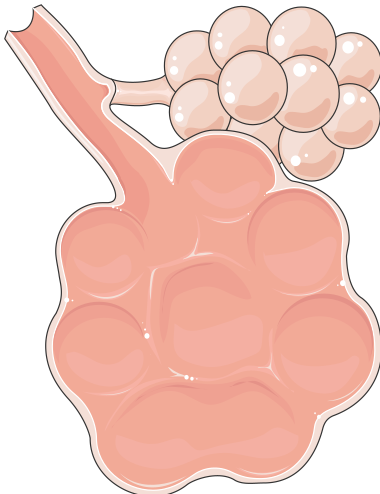
How RTs assess and manage an acute COPD exacerbation — controlled oxygen to 88–92%, combined SABA/SAMA bronchodilators, steroids, antibiotics, and NIV for hypercapnic respiratory acidosis.
ARDS Basics
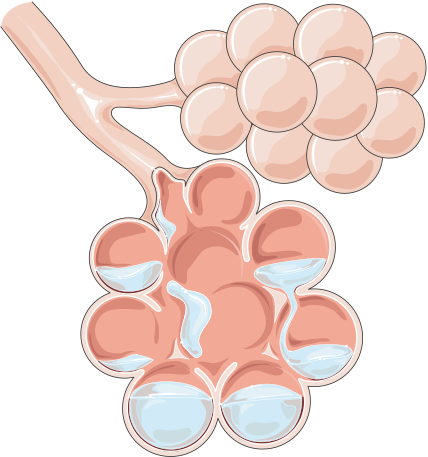
The Berlin definition, pathophysiology, and lung-protective ventilation of ARDS — 6 mL/kg of predicted body weight, plateau ≤ 30 cmH₂O, permissive hypercapnia, PEEP titration, and prone positioning.
Weaning & Spontaneous Breathing Trials
Run a spontaneous breathing trial — the daily readiness screen, SBT mechanics and failure criteria, RSBI, and why passing the SBT isn't extubation.
Featured References
Quick bedside lookups for when you need the number now.
Normal ABG Values
Reference ranges for arterial blood gas values — pH, PaCO₂, PaO₂, HCO₃⁻, base excess, and SaO₂ — with venous comparison values and hypoxemia severity thresholds.
Ventilator Alarm Troubleshooting
A bedside matrix for common ventilator alarms — high and low pressure, high and low rate, and high minute ventilation — with likely causes, first actions, and the DOPE approach to acute deterioration.
Oxygen Device Flow Ranges & FiO2
Flow rates and approximate FiO₂ delivered by common oxygen devices — nasal cannula, simple mask, Venturi mask, partial and non-rebreather, HFNC, and trach collar — with the low-flow vs high-flow distinction.
Featured Charts
Side-by-side comparisons built for pattern recognition.
ABG Disorder Comparison Chart
Side-by-side comparison of the eight core acid-base disorders — pH, PaCO₂, and HCO₃⁻ direction, common causes, and hallmark signs — with normal ABG ranges for quick bedside reference.
Ventilator Modes Comparison Chart
Side-by-side comparison of the common ventilator modes — AC/VC, AC/PC, SIMV, PSV, PRVC, APRV, and CPAP — showing what you set, what varies, whether minute ventilation is guaranteed, and what to watch for.
COPD vs Asthma Chart
Side-by-side comparison of COPD and asthma — onset, reversibility, triggers, inflammation, disease course, and acute treatment overlap — with the ABG red flags that separate them.
Printables & Learning Pathways
Free print-ready forms for the bedside and the study desk, plus curated routes through the library for every stage.
Free · Print-ready
Printables
Brain sheets, ventilator flow sheets, ABG worksheets, and TMC & CSE study planners — formatted to print clean.
Browse all printables →Guided
Learning Pathways
Start where you are — curated routes through the library for students, new grads, and practicing RRTs.